
May 11, 2026 | Chase Sanford
I recently had a client in her early 30’s receive an alarmingly low bone density score on her first ever DEXA scan, showing that she was in range for Osteopenia and currently in the 7th percentile for her age. 7th! This finding came as a surprise to the both of us, as she is a healthy individual who has been showing great progress in her training program. The concern is that this is something that can become very serious as you age. In adults over 65, hip fractures carry roughly a 7% mortality rate within 30 days, 15% within 90 days, and nearly 30% within a year. If nothing changes in the next 20-30 years, my client’s bone density score in the 7th percentile would put her at major risk of having a catastrophic result from a fall. *One key point to be made here: Body composition DEXA scans are not diagnostic bone density tests only providing a bone density snapshot rather than a complete clinical picture.
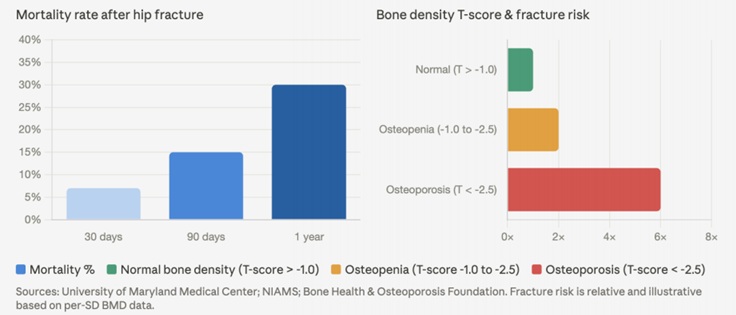
Even osteopenia — the middle category — carries significantly elevated fracture risk. Combined with the mortality rates associated with hip fractures in older adults, a low bone density score in your 30s isn’t something to ignore.
Before making any changes to her program, I wanted to loop in her doctor, not because I expected anything alarming, but because before increasing load or adding high-impact movements, I wanted to hear from a medical professional that it was safe to do so. At her appointment the doctor was not overly concerned (though he did refer her to a specialist) and encouraged her to continue training. That clearance mattered because it gave her confidence that training harder was not only okay but encouraged, and frankly it gave us both peace of mind that we’re not putting her at risk of injury.
So how did this bombshell change her training program? Less than you might think. Her initial goals when we began training 3 months ago were pretty straightforward and centered around strength and body composition, so we had already focused extensively on building a solid strength foundation in her 3x/week program. She had been an ideal client with her consistent attendance and effort and as a result had made significant progress in her strength and flexibility.
After reevaluating her program in light of the new emphasis on bone density, we recognized that while an overhaul of her programming wasn’t necessary, there were some adjustments that we could make that would likely shift the trajectory of her bone health.
Bone tissue responds to impact differently than it does to slow, controlled loading. When force is applied quickly, like landing from a jump, it creates a brief spike of compressive stress that signals the bone to adapt and rebuild. This is why impact training is a distinct stimulus, not just a harder version of strength work.
To introduce this, we added banded pogos, squat jumps, and a multi-planar leap matrix. The goal was to take movements she was already comfortable with and layer impact on top, preserving the movement patterns she’d built while adding a new stimulus her bones hadn’t been exposed to. The leap matrix in particular added something the other movements didn’t: directional variety. Where pogos and squat jumps load the bone vertically, the leap matrix introduces force from multiple angles, stimulating broader adaptation across the bone’s structure. For someone whose bones need to become more resilient in real-world situations, not just straight-line movement, that multi-planar component matters.
When bones are placed under load, something similar to what happens in muscle tissue occurs. Bone cells called osteocytes sense the mechanical strain and trigger a controlled breakdown of bone tissue. This recruits osteoblasts; the cells responsible for building new bone, which respond by laying down denser, stronger material. The greater the strain, the stronger the adaptive signal. This is why progressive overload isn’t just a muscle-building principle, it’s one of the most evidence-backed tools for improving bone density as well.
The good news is she was already doing this. Two months of consistent progressive overload had been building a foundation without either of us fully appreciating the bone benefit happening alongside the strength gains. This adjustment wasn’t a departure from her program, it was a deliberate refocusing on something already working. We increased the weight to prioritize peak force on her key compound movements, doubling down on the stimulus her bones were already responding to. We chose movements she had consistently demonstrated good form on; dumbbell bench, kettlebell squats, and trap bar deadlift. Those were the movements she had earned the right to load heavier. Jumping to heavier weights on movements that haven’t been mastered increases injury risk without meaningfully increasing the bone stimulus, so the foundation she’d built mattered here.
Prioritizing spinal loading means deliberately choosing movements that direct force through the spine; squats, deadlifts, and carries rather than movements where the spine is unloaded or supported. This matters because vertebral fractures are one of the primary concerns with low bone density, and the spine responds to the same principle as everything else: load it progressively and it will adapt.
Conveniently, the movements she had already mastered; the trap bar deadlift and kettlebell squats — are among the best axial loading movements available. The heavier loading we introduced in the previous section wasn’t just building overall strength, it was sending a direct adaptive signal to the vertebrae. This is also where farmer carries come in; a real world movement adding impact with each step while also loading the spine.
These adjustments were specific to where she was in her training; her movement history, her demonstrated competency under load, and the foundation she’d built over two months of consistent work. The starting point and rate of progression will look different for everyone. But the framework doesn’t change much: introduce impact, load progressively, and make sure some of that load is traveling through the spine. The variables shift, the principles don’t. At the end of the day, improving bone density isn’t about overhauling your entire routine overnight — it’s about making the right adjustments and staying consistent long enough to let your body adapt. The same way poor habits can slowly weaken your bones over time, the right training can steadily build them back up. Start where you are, progress at a pace your body can handle, and focus on doing the basics well. If you do that, you’re not just improving bone density — you’re building a body that will support you for years to come
Sources:

Customized nutrition and wellness coaching tailored to you, empowering sustainable ways of approaching food, exercise, sleep, and stress management. Whether you need some knowledge-based guidance on your journey to finding nutritional balance, some supportive structure to meet specific goals, or incorporate a body positive approach with food that lifts you up rather than tears you down, our nutrition and wellness coaching provides you with tools and ongoing support to develop your own unique healthy balance. Learn More